
Quick Answer
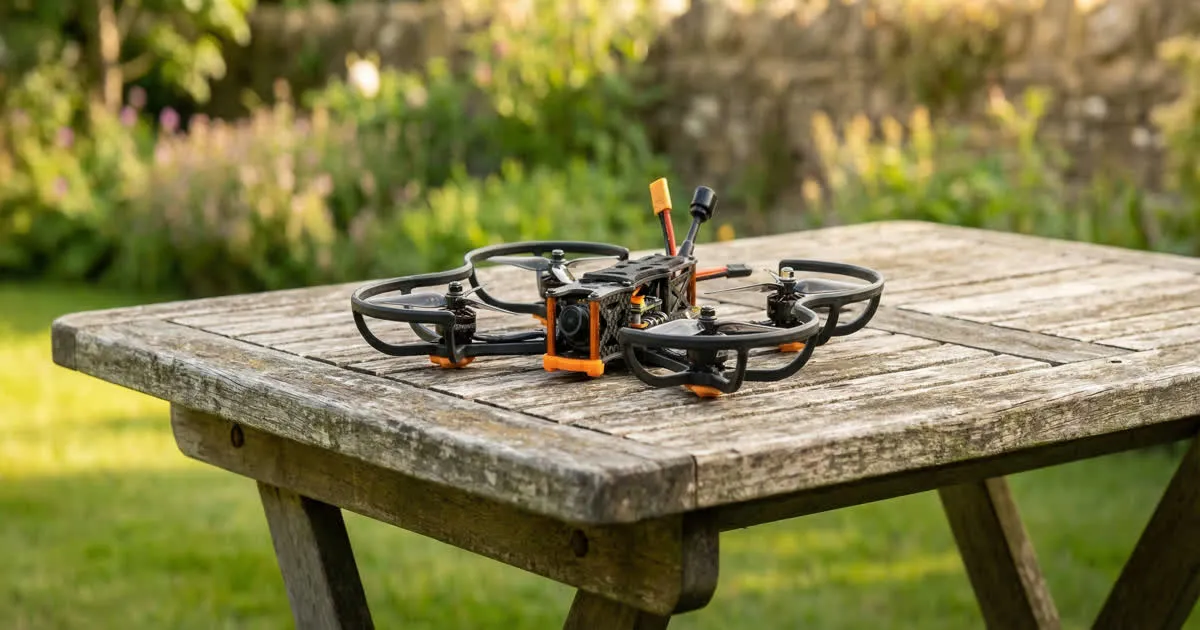
An FPV drone is a small aircraft you fly while watching a live video feed from its onboard camera. You see through the drone's eyes instead of watching it from the ground. A radio link sends your stick moves to the drone, and a separate video link sends the camera picture back to your goggles or a screen.
The Two Links That Make FPV Work
Every FPV drone depends on two radio links working at the same time.
The control link carries your commands. When you move the sticks on your radio, that signal travels to a small receiver on the drone. The receiver passes your commands to the flight controller, which is the small computer that runs the drone.
The video link carries the picture. A tiny camera on the front of the drone sends live video to a video transmitter, often called a VTX. The VTX sends that picture through the air to your goggles or screen.
These two links use separate hardware and often separate frequencies. If one link drops out, the other can keep working for a moment. That is one reason a strong failsafe setup matters, which we cover in our guide on flying an FPV drone safely.
What "First Person View" Actually Means
The name FPV stands for first person view. Instead of standing behind the drone and watching it in the sky, you put on goggles and see exactly what the drone's camera sees. This changes how you fly.
You are not judging distance by eye from the ground. You are reacting to a picture in real time, much like playing a fast video game. But the drone is real, and it can break or hurt someone if you crash it into the wrong thing.
The Parts Working Together
An FPV drone is a set of small parts that all depend on each other. Here is the short version of how they connect. For the full breakdown, read our guide on FPV drone parts explained.
- Frame: the structure that holds everything.
- Motors and propellers: create the thrust that lifts and moves the drone.
- Electronic speed controllers (ESCs): tell each motor how fast to spin.
- Flight controller: reads sensors and adjusts motor speed many times per second to keep the drone stable.
- Camera and VTX: capture and send the video feed.
- Receiver: picks up your control commands.
- Battery: powers everything, usually a LiPo pack.
Each part is small and light. Weight matters a lot, because every extra gram needs more power to lift.
Acro Mode vs Angle Mode
New pilots often ask about flight modes. These control how the drone reacts to your stick inputs.
Angle mode limits how far the drone can tilt. If you let go of the sticks, the drone levels itself back out. This makes angle mode easier to learn, since the drone will not flip over by accident.
Acro mode, also called rate mode, removes that limit. The sticks control how fast the drone rotates, not a fixed angle. The drone will not level itself. This gives full control for tricks, sharp turns and smooth cinematic moves, but it takes practice to fly well.
Most pilots start in angle mode for their first flights, then move to acro mode once they feel steady on the sticks. A flight simulator is the safest place to make that switch.
Who Flies FPV Drones
FPV started as a hobby for people who wanted to fly like they were sitting in the cockpit. It has grown into several distinct uses.
- Freestyle pilots fly tricks and flowing lines through parks, buildings and natural terrain, often for video content.
- Racers fly fixed courses through gates as fast as possible, competing against other pilots in real time.
- Cinematic pilots fly slow, smooth shots for films, real estate, and events, sometimes on larger "cinelifter" drones carrying a real camera.
- Professional filmers combine FPV skill with camera knowledge to get shots a standard drone cannot capture. This includes flying through a doorway or chasing a moving car at ground level.
If you are trying to decide whether FPV or a normal camera drone fits your project, our guide on FPV drone vs camera drone compares the two directly.
Why FPV Feels Different From Other Drones
A standard camera drone, like the kind most people picture, uses GPS to hold its position in the air. Let go of the sticks and it hovers in place. Many FPV drones can also use GPS, but pilots usually fly with it off, using only their own hand-eye coordination to keep the drone stable.
This is why FPV flying takes practice. There is no computer holding the drone steady for you in acro mode. The skill lives in your hands, which is also why FPV footage often looks more alive and more connected to real speed and motion.
Getting Started the Right Way
If the idea of flying FPV interests you, do not start by buying an expensive drone. Start with a simulator connected to a real radio, so you build stick skills without any crash risk. Once you can hold a stable hover and fly basic lines, a small, cheap drone like a tiny whoop is a safe next step.
Our guide on choosing your first FPV kit walks through the exact options for a beginner, including ready-to-fly kits that need no building at all.