Quick Answer
For a true first FPV kit, choose a ready-to-fly (RTF) bundle over building your own, pick a small tiny whoop or 3-inch drone rather than a fast 5-inch, and start with a simple, reliable video system. This combination gets you flying quickly with the lowest cost of mistakes while you learn the basics.
RTF vs BNF: What Is the Difference?
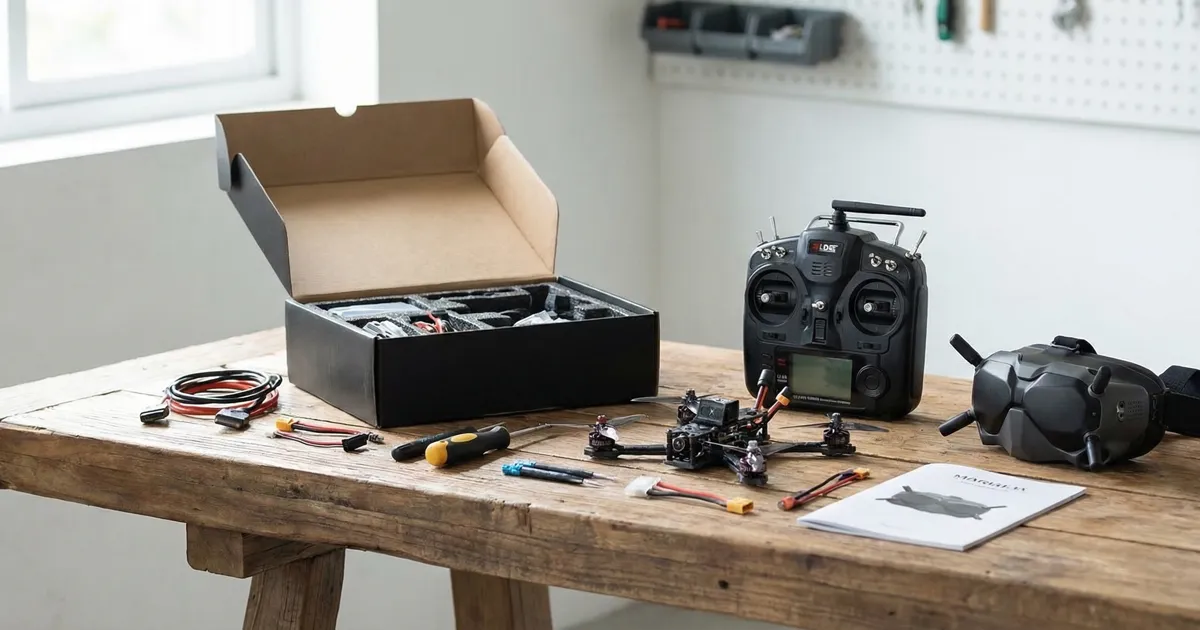
Ready-to-fly (RTF) kits include everything you need: the drone, a radio, and usually goggles, all matched and ready to bind and fly out of the box. This is the simplest path for a first kit, since you avoid the guesswork of matching separate parts.
Bind-and-fly (BNF) kits include the drone alone, built and tested, but expect you to already own a compatible radio. This suits someone who already flies FPV or another RC hobby and just needs a new drone.
If this is your very first time flying FPV, go with RTF. You remove the risk of buying a radio that does not work with your drone, and you get a full, tested system from one source.
Tiny Whoop vs 3-Inch vs 5-Inch as a First Drone
Drone size matters more for a beginner than most other specs.
Tiny whoops are small drones with propellers protected by plastic ducts. They are safe to fly indoors, cheap to repair, and forgiving of crashes into walls or furniture. This makes them the easiest and safest starting point, especially if you plan to practice at home. Their tiny brushless motors come in sizes like 0702 and 0802, and our 0802 vs 0702 motor comparison explains the difference.
3-inch drones sit between a whoop and a full-size freestyle drone. They are light enough to fly in a backyard or small field, faster than a whoop, but still cheap enough that crashes do not hurt your budget. Many pilots use a 3-inch as their first outdoor drone.
5-inch drones are the standard size for freestyle and racing. They are fast, powerful and capable of real cinematic footage, but they are also harder to control for a total beginner and more expensive to repair after a crash.
Our advice: start on a tiny whoop indoors, move to a 3-inch once you are comfortable, and only buy a 5-inch once you can hold a steady hover and fly basic lines without crashing constantly.
Analog vs Digital as a Starter System
FPV video systems come in two types, and this choice affects both cost and image quality.
Analog video is simpler and cheaper. The picture has more static and lower resolution, but the gear costs less and the system is easy to understand. Many starter kits use analog for this reason.
Digital video, such as the systems from DJI or Walksnail, gives a much clearer, sharper picture. It costs more, and the goggles and air unit need to be replaced together as a matched pair, which adds to the price.
For a first kit, analog is a perfectly good choice. It teaches you the fundamentals without a big investment, and you can upgrade to digital later once you know FPV is a hobby you want to continue. If you want the full comparison, see our guide on analog vs digital FPV.
Radio and Goggles: What to Look For
A beginner radio does not need every feature. Look for one with a comfortable feel in your hands, smooth gimbals for stick movement, and support for ExpressLRS, an open control system used widely across the hobby.
For goggles, box-style goggles are the cheapest and most basic option, while slim, lightweight goggles cost more but feel less bulky on your face. Our guide on choosing FPV goggles breaks down the differences in far more detail.
A Simple Checklist Before You Buy
Work through this list before spending money on your first kit.
- Decide indoor, outdoor, or both, since that decides whoop vs 3-inch as your starting size.
- Choose RTF if this is your first FPV purchase.
- Pick analog video for a lower-cost, simpler starting system.
- Confirm the kit includes a battery charger, or add one to your order.
- Buy at least two extra batteries beyond what comes in the box.
- Download a flight simulator and start practicing before your first real flight, covered in our guide on FPV simulators.
- Read up on basic safety habits in our guide on flying FPV safely before you fly around other people.
Common First-Kit Mistakes
A few mistakes show up again and again with new pilots.
- Buying a 5-inch freestyle drone as a first purchase. It looks impressive, but the speed and power make it hard to control while learning basic stick skills.
- Skipping the simulator. Practicing stick control on a simulator first saves real money in crashed parts.
- Buying separate parts before understanding what each does. A mismatched radio and receiver can leave you stuck before you even fly. RTF kits avoid this problem entirely.
- Ignoring spare parts. Even a durable tiny whoop needs occasional new propellers. Buy spares with your first order.
Putting It All Together
The safest, most cost-effective first FPV kit is a ready-to-fly tiny whoop or 3-inch drone with an analog video system, paired with a simple radio and basic goggles. This setup gets you flying fast, keeps crash costs low, and gives you room to grow into bigger drones and better gear once your stick skills catch up.