
Quick Answer
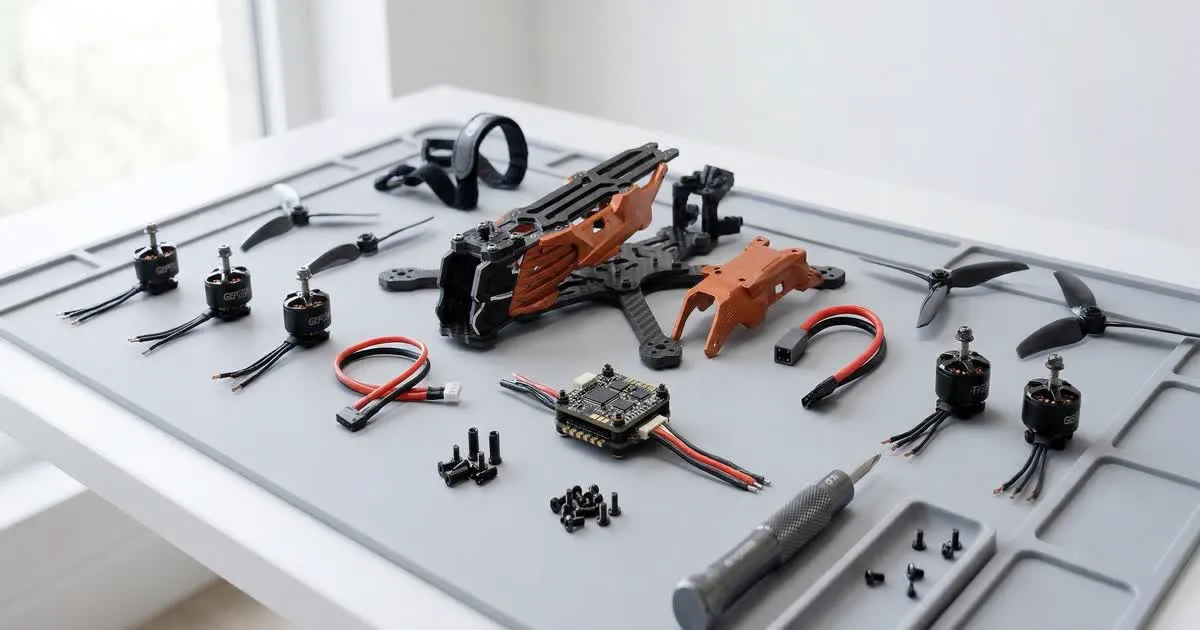
An FPV drone is built from a small set of parts that all work together: a frame, motors, propellers, electronic speed controllers, a flight controller, a camera and video transmitter, a receiver, antennas, a battery, and a separate radio and goggles for the pilot. Each part has one clear job, and understanding what each does makes the whole machine much less confusing.
The Frame
The frame is the skeleton of the drone. It is usually made from carbon fiber, which is light and strong. Every other part bolts, plugs or straps onto the frame.
Frames come in different sizes, measured by the propeller size they fit, such as 3-inch, 5-inch or 7-inch. Bigger frames carry bigger batteries and cameras but weigh more. Smaller frames are lighter and more agile, which suits tight spaces and indoor flying.
Motors and Propellers
Motors spin the propellers to create lift and thrust. FPV drones use brushless motors, which are more efficient and last longer than the brushed motors found in cheap toys.
Motors are rated by size and by KV, a number that describes how fast the motor spins per volt of power. Higher KV motors spin faster with smaller propellers. Lower KV motors spin slower with bigger propellers, which usually gives smoother, more efficient flight.
Propellers come in two, three or four blade versions. More blades generally mean more grip and a smoother feel in the air, but slightly less top speed and battery life.
Electronic Speed Controllers (ESCs)
Each motor needs its own electronic speed controller, or ESC. The ESC takes commands from the flight controller and adjusts how much power reaches the motor, changing its speed many times every second.
ESCs run firmware, which is the small program controlling how they operate. Common ESC firmware includes BLHeli_S, AM32 and Bluejay. Good ESC firmware makes motors run smoother and cooler, which matters more than most new pilots expect.
The Flight Controller
The flight controller is the brain of the drone. It is a small circuit board packed with sensors, including a gyroscope that detects rotation and often an accelerometer that detects tilt.
Many times per second, the flight controller reads these sensors, compares the result to your stick inputs, and tells each ESC how to adjust motor speed to keep the drone stable and responsive. This happens far faster than a human could react manually.
Flight controllers run firmware too, most commonly Betaflight for freestyle and racing drones. If you want to go deeper on this part, our guide on what a flight controller is and does covers it in full.
Camera and Video Transmitter (VTX)
The camera captures the live view the pilot flies with. It connects to a video transmitter, or VTX, which sends that picture through the air to the pilot's goggles.
FPV video systems come in two main types: analog, which is simple and cheap with lower image quality, and digital, which gives a much clearer picture at a higher cost. Our guide on FPV drone vs camera drone touches on how camera choice affects the footage you get.
Receiver and Antennas
The receiver picks up commands from the pilot's radio and passes them to the flight controller. It is paired, or "bound," to one specific radio, so the drone only listens to its own pilot.
Antennas matter more than most beginners realize. The receiver has its own small antenna for the control link, and the VTX has a separate antenna for video. Damaged or poorly placed antennas cause weak signal, dropped video, and in the worst case, a lost drone.
Battery
Almost all FPV drones run on lithium polymer batteries, known as LiPo packs, though some long-range builds use lithium-ion cells instead. The battery plugs directly into the frame and powers every other part.
Battery choice affects flight time, power available for tricks, and overall weight. Picking the right pack means balancing capacity against weight, which our guide on choosing your first FPV kit explains for new pilots buying their first setup.
Radio and Goggles: The Pilot's Half
Two more parts complete the system, and neither one is attached to the drone.
The radio, also called a transmitter, is the handheld controller with two sticks. It sends your movements to the receiver on the drone.
The goggles receive the video signal from the VTX and display it in front of the pilot's eyes. Some goggles use a screen inside a headset; others use a simpler box design with a smaller field of view.
Together, the radio and goggles are what make a drone an FPV drone. Without them, you have a normal remote-control aircraft with no live video feed.
How It All Fits Together
Here is the simple chain of events during flight, in order:
- You move the sticks on your radio.
- The receiver on the drone picks up that signal.
- The flight controller reads the signal along with its own sensors.
- The flight controller tells each ESC how much power to send.
- The ESCs spin the motors, moving the drone.
- At the same time, the camera sends a live picture through the VTX.
- Your goggles display that picture, so you can see and react.
This entire loop repeats hundreds of times per second, which is why a well-tuned drone feels instant and direct to fly.