Quick Answer
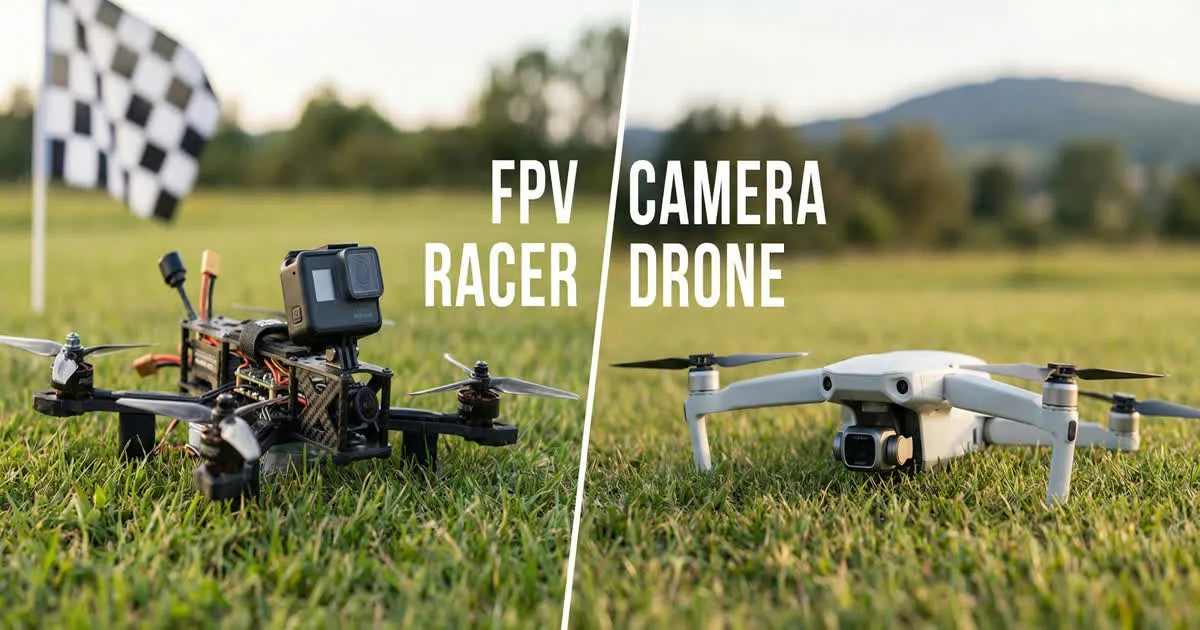
A camera drone uses GPS to hover and fly smooth, stable paths on its own, which makes it easy to learn and great for wide, calm aerial shots. An FPV drone is flown by hand through a live video feed, with no GPS holding it steady, which lets skilled pilots fly fast, close and through tight spaces. Most filming projects benefit from having access to both.
What Each Drone Actually Does
A camera drone, sometimes called a "GPS drone," flies itself in the background. Its onboard computer uses GPS and other sensors to hold a position in the air. Let go of the controls and it stays put. This makes it simple to fly a slow, steady line for a wide establishing shot.
An FPV drone has no such safety net in its normal flying mode. The pilot watches a live video feed through goggles and controls every movement by hand. There is no automatic hover. This takes real practice, explained in our guide on what an FPV drone is and how it works, but it opens up movement a camera drone cannot match.
The Shots Each One Gets
This is the biggest practical difference, and the reason many productions use both drone types.
Camera drones are best for:
- Wide establishing shots of a landscape or building
- Smooth, slow reveals from high altitude
- Steady tracking shots at a safe, moderate speed
- Shots where a stable, predictable frame matters more than raw energy
FPV drones are best for:
- Fast fly-throughs of doorways, gaps and tight corridors
- Chase shots that match the speed of a car, bike or runner
- Fluid, swooping camera moves that follow terrain closely
- Dramatic reveals that fly from ground level straight up into the sky
If you only need one calm, wide shot of a property or a landscape, a camera drone alone may be enough. If the brief calls for energy, speed or a shot that flies through a space, FPV is often the only way to get it.
Learning Curve and Skill
A camera drone is built to be approachable. Most models let a new pilot take off, hover, and fly a basic path within a single session. The GPS hold forgives small mistakes.
An FPV drone demands real training time. Flying by video feed alone, with no automatic stabilization, means a new pilot will crash while learning. This is why serious FPV training almost always starts on a simulator, covered in our guide to FPV simulators, before any real drone leaves the ground.
For a filming client, this difference matters. A camera drone can often be flown competently by someone with a few hours of practice. FPV footage that looks smooth and controlled usually comes from a pilot with months or years of stick time.
Safety Considerations
Camera drones are generally considered lower risk for casual and semi-professional use, because the GPS hold reduces the chance of a sudden, uncontrolled movement. They still require care around people, buildings and airspace rules.
FPV drones carry more risk during flight, since a lost video signal or a pilot mistake can send the drone into an uncontrolled path for a moment. Professional FPV pilots manage this risk through practice, redundant safety settings, and by keeping non-essential people clear of the flight path. Our guide on flying an FPV drone safely covers the habits that keep this risk low.
For any filming job near people, crowds or property, the pilot's experience and safety planning matter more than the type of drone.
Video Quality and Camera Options
Modern camera drones usually come with a strong built-in camera, often shooting high-resolution video and stills straight out of the box, with a stabilized gimbal that keeps the image smooth even in wind.
FPV drones vary more. Racing and freestyle setups often use a lightweight, low-latency camera built for reaction speed, not top image quality. For filming work, pilots add a separate action camera or small cinema camera to the frame, giving high-quality footage while the pilot flies by the lower-quality FPV feed. This split setup is common on cinelifter builds used for professional shoots.
Cost to Get Started
A ready-to-fly camera drone is usually a single purchase that includes the drone, controller and camera in one box, which keeps the starting cost predictable.
Getting into FPV involves more separate pieces: the drone itself, a radio, goggles, batteries, a charger and spare parts for crashes while learning. Our full FPV cost breakdown walks through what a realistic budget looks like at different levels.
Which One Should You Choose?
Think about the shots you actually need, not the drone that looks more exciting.
| Need | Better fit |
|---|---|
| Wide, calm landscape or property shots | Camera drone |
| Fast, close, or fly-through shots | FPV drone |
| Quick results with little practice | Camera drone |
| A dramatic, high-energy edit | FPV drone |
| One drone for many simple jobs | Camera drone |
| A specific, hard-to-get creative shot | FPV drone with a trained pilot |
For a business hiring out aerial filming, the honest answer is often "both." A camera drone covers the safe, wide shots, and an FPV drone adds the moments that make a video stand out. If you are planning a shoot and are not sure which fits your project, our filming services page can help you figure out the right setup.