
Quick Answer
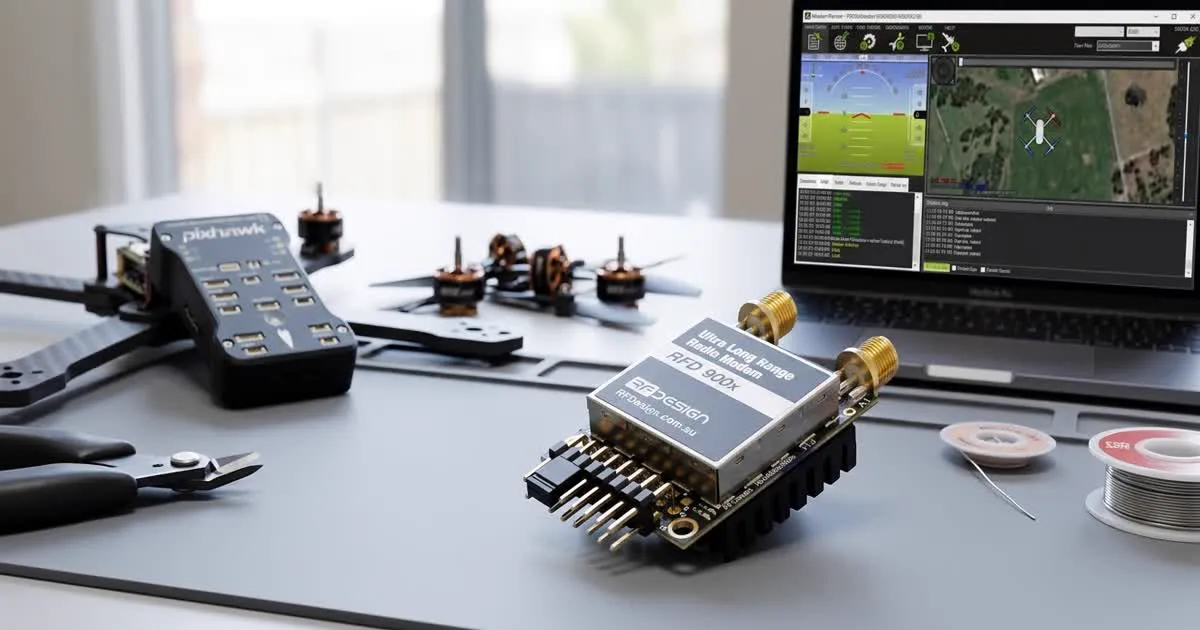
RFD900x and RFD868x are the same telemetry radio family on different frequencies, 915 MHz and 868 MHz, chosen to match regional regulations. The UX versions are smaller and lighter, built for weight-sensitive drones, usually with a modest trade-off in transmit power or antenna options. Pick your frequency by region first, then choose x or UX by weight and space.
Same Radio Family, Different Frequencies
RFD900x and RFD868x share the same core design. They also share the same basic features. The main difference is the frequency band each one uses. The 900 name refers to the 915 MHz band. This band is common in the United States and several other countries. The 868 name refers to the 868 MHz band. This band is common across Europe and other regions that regulate that range instead.
This split exists for a simple reason. Each country or region sets its own radio frequency rules, not one global rule. A radio legal at full power in one country may be restricted in another. Choosing between 900x and 868x is mostly about where you plan to fly. It is not about a real performance gap between the two bands.
Checking Which Band Applies to You
Before buying either version, check your country's rules for the 868 MHz and 915 MHz bands. Some countries permit one band freely for this kind of use, restrict the other, or apply different power limits to each.
Do not assume based on where you bought the radio. Import listings do not always reflect local telecom rules. Confirm directly with your national telecom or aviation authority if you are unsure which band and power level are legal for you to use.
x vs UX: Size and Weight
The UX versions of these radios are built smaller and lighter than the standard x versions. This matters most on weight-sensitive builds, such as smaller long-range quads or fixed-wing aircraft where every gram affects flight time.
| Feature | Standard (x) | UX |
|---|---|---|
| Size | Larger | Smaller |
| Weight | Heavier | Lighter |
| Typical use | General builds, ground stations | Weight-sensitive air units |
| Antenna options | Often more flexible | Sometimes more limited |
The smaller UX size sometimes means a more limited antenna connector or a lower maximum transmit power, depending on the specific model. Check the current specification sheet for the exact model you are considering, since details can change between hardware revisions.
Power Output and Range
Higher transmit power usually extends range. This holds true up to the legal limit set for your region and radio class. The standard x versions often support higher power settings than the compact UX versions. Both types can still be set to lower power for shorter-range missions.
Range depends on far more than transmit power alone, though. Antenna choice, mounting, terrain, and interference from other radios all shape real-world range. These factors matter as much as the radio's rated output. Our long-range antenna guide covers how to get the most from whichever modem you choose.
Choosing by Region and Airframe
A simple way to decide:
- First, confirm which frequency band, 868 MHz or 915 MHz, is standard and legal where you fly.
- Then, decide if your airframe is weight-sensitive enough to justify the UX version's smaller size.
- If you plan to combine telemetry with control on one radio module, also look at the RFD TXMOD, which is a related product built for that combined use.
- If your project needs to meet specific government or enterprise sourcing rules, check our NDAA compliance guide as well.
Do not choose a modem based on frequency alone if you travel between regions with your drone. Confirm the rules for every country you plan to fly in, not just your home country.
Setting Up Whichever Modem You Choose
Both the x and UX versions configure the same way through RFD Tools, matching Net ID, air data rate, and frequency settings between the air and ground units. If you are setting one up for the first time, our RFD900 ArduPilot setup guide walks through the process step by step, and the same steps apply to the 868 MHz versions.
Comparing Total Weight on the Airframe
Weight adds up fast on a long-range build. A telemetry radio, its antenna, and its connecting cable all add grams on top of your flight controller, GPS, and control link hardware.
On a 7-inch or larger long-range quad, a standard modem and a UX modem may differ by only a few grams. That small gap barely affects flight time. On a smaller fixed-wing aircraft built for maximum endurance, that same gap can matter more. Every gram reduces glide efficiency and cuts into flight time. Weigh your complete radio setup, antenna included, before you decide it is light enough for your airframe.
Planning for Future Upgrades
If you expect to add more payloads later, such as a camera gimbal, a mapping sensor, or a companion computer, plan your radio choice with some spare weight and space budget in mind. A UX modem chosen purely to save a few grams today may leave less room for cables and mounting later.
Buying a modem that fits your current mission with some margin left over is usually a better long-term choice than picking the smallest option available. Our long-range FPV drone build guide covers this kind of weight planning across a full build, not just the radio.