Quick Answer
NDAA compliance refers to rules in United States law. These rules stop government agencies and certain contractors from buying drones or drone parts, including radios, from a specific list of manufacturers. That list covers makers seen as a security risk. If you sell to the US government, or work on many enterprise contracts, your radios usually need to meet these rules.
What NDAA Compliance Actually Means
NDAA stands for the National Defense Authorization Act. It is a US law passed and updated each year. Certain sections of this law restrict federal agencies. Those agencies cannot buy or use equipment, including drones and drone parts, from a specific list of named manufacturers and their subsidiaries.
For a drone radio, this rule reaches down to the parts level. The radio's manufacturer must not be on the restricted list. Often, the maker of its key chips must not be on that list either. A radio labeled NDAA-compliant is one the maker claims meets these sourcing rules.
Who Actually Needs This
Not every drone builder needs to worry about NDAA compliance. It mainly matters if you fall into one of these groups:
- You sell drones or drone parts to US federal agencies.
- You work under a contract that requires compliant equipment. This is common in defense, public safety, and some infrastructure projects.
- You supply a state or local agency that has adopted similar rules. This is becoming more common over time.
If you build a personal or hobby long-range drone, NDAA compliance is unlikely to matter to you directly. It becomes important once government money or a government contract enters the picture.
Why It Matters Beyond Just Legal Rules
Some organizations prefer NDAA-compliant gear as a general policy, even outside strict legal rules. This signals a supply chain that has already been reviewed for this specific risk. It can matter to enterprise clients too. They may want to avoid future compliance headaches, even if their current contract does not strictly require it yet.
Buying compliant equipment from the start can save you trouble later. If a contract's rules change, or a new client asks for compliant gear, you will not need to replace radios you already own.
How to Check a Manufacturer's Claims
A label that says "NDAA compliant" is a claim. It is not automatic proof on its own. To check it properly, take these steps:
- Ask the manufacturer for documents that show which parts of the law their product meets.
- Check if the claim covers the whole radio, including internal chips, or just the outer branding.
- Look for any third-party certification or past government contract history that backs up the claim.
- If you are buying for a specific contract, confirm the exact requirement with your contracting officer or client. Requirements can vary between contracts.
Do not assume compliance just from price or brand reputation. Ask for the specific documents your contract actually requires.
Example Categories of Compliant Radios
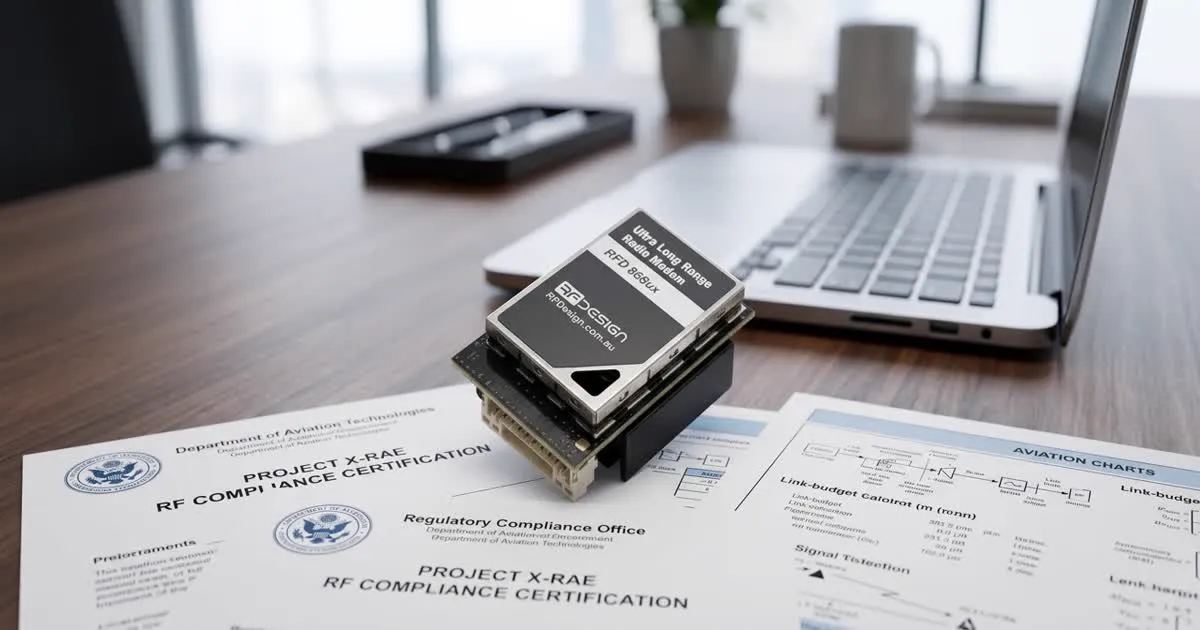
Some manufacturers market compliant versions of their radios. This includes certain RFD-brand telemetry radios and Microhard-brand IP radios. Our Microhard radio guide and RFD modem comparison cover these radios in general technical detail. Those two guides do not cover compliance questions, though.
Compliance rules can change as the law is updated each year. Always confirm current rules with your contracting officer or legal team. Do not rely on an older article, or on a radio's original packaging.
Compliance Is Not the Same as Performance
An NDAA-compliant radio is not automatically better or worse at its real job. Its job is sending data over distance. Compliance is about the supply chain and the manufacturer. It says nothing about range, data rate, or build quality on its own.
When you compare compliant radios for a project, judge their technical performance the normal way. Look at range needs, data rate, and frequency band. Check how well the radio fits your mission. Do this alongside checking its compliance documents, not instead of it.
Keeping Records for Future Contracts
If your work involves government or enterprise contracts now, it is worth keeping records even for gear you buy today. Save the compliance documents a manufacturer gives you, along with the date you bought each radio and which contract it was for.
Rules and lists can change over time. A radio that is compliant today may need a fresh check a few years later. A simple folder of receipts and compliance letters makes that future check much faster. It also helps if a client or auditor asks you to prove compliance after the fact, sometimes long after the original purchase.
A Quick Word on Cost
NDAA-compliant radios can cost more than similar radios that skip this extra sourcing review. That higher cost usually comes from tighter control over parts and suppliers, not from better range or build quality on its own.
Do not treat price as proof of compliance, and do not treat compliance as proof of better performance either. Judge cost, compliance, and performance as three separate questions when you plan a purchase for a government or enterprise project.