Quick Answer
Choosing a long-range antenna means balancing gain against beam width: a higher-gain antenna reaches further but covers a narrower area, so it needs more careful aiming. Test range on the ground first, moving away in stages while watching signal quality, rather than guessing at your drone's limit in the air.
Gain and Beam Width, in Plain Terms
Antenna gain describes how well an antenna focuses radio energy in a certain direction, instead of spreading it evenly in every direction. A higher-gain antenna sends a stronger signal in its favored direction, but a weaker one everywhere else.
Beam width describes how wide that favored direction is. A high-gain antenna usually has a narrow beam width, like a flashlight beam instead of a bare light bulb. That trade-off matters because a narrow beam must be aimed at the drone, while a wide beam covers more sky without aiming.
Common Antenna Types
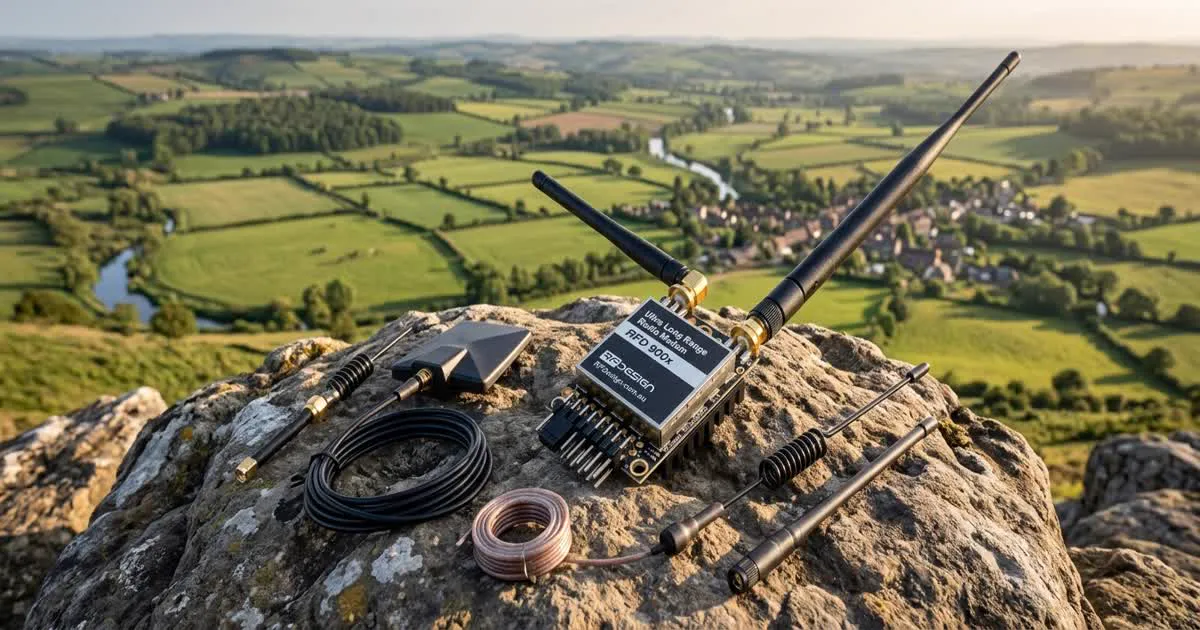
- Dipole or whip antennas send and receive in a wide, roughly donut-shaped pattern around the antenna. They need little aiming and suit a drone that flies in many directions.
- Patch antennas focus signal in one general direction with moderate gain. They work well on a ground station pointed toward your flying area.
- Yagi antennas focus signal tightly in one direction with high gain. They reach the furthest but need active aiming as the drone moves, or a tracker that turns automatically.
Most builders use a wide-pattern antenna on the drone, since the drone's orientation keeps changing, and a more directional antenna on the ground station, since the ground station stays fixed.
Mounting and Separation
Mount antennas away from carbon fiber and other conductive materials, which block and reflect radio signals. On a drone, this often means mounting antennas on arms or a mast that clears the frame and battery.
Keep antennas for different radios, such as control and video, spaced apart from each other. Two antennas mounted too close together can interfere, even on different frequencies. On the ground, mount your antenna as high as practical, since height clears more obstacles and extends line of sight.
Understanding Link Budget Simply
A link budget is the balance between how much signal a radio sends and how much signal is lost before it reaches the receiver. Losses come from distance, obstacles, cable length, and connector quality.
You do not need to calculate a full link budget to fly long range, but it helps to know what improves it:
- Higher transmit power sends a stronger starting signal, within your region's legal limit.
- Higher gain antennas focus more of that signal where you need it.
- Shorter, higher-quality cables between the radio and antenna waste less signal as heat.
- A clear line of sight avoids losses from obstacles blocking the path.
Improving any of these extends your usable range. Weakness in one area, such as a bad cable, can undo gains made elsewhere.
Confirm your antenna's frequency matches your radio exactly. An antenna built for the wrong band will perform poorly, even if everything else is set up well.
A Safe Way to Test Range on the Ground
Before trusting a link in the air, test it on the ground. Set the drone at a fixed spot, then walk or drive away with the ground station, watching signal quality in your radio's software or on your radio's display.
Note the distance where signal quality starts to drop noticeably. Repeat this test in the actual area you plan to fly, since terrain, trees, and buildings change results from one location to another. A range figure from open flat ground will not match a range figure from a hilly or wooded area.
Building in a Safety Margin
Whatever range your ground test shows, plan your real flights well inside that limit. Weather, battery voltage, and even the angle you hold the ground antenna at can all change performance slightly from one day to the next.
A good rule is to treat your tested range as a maximum, not a target. Fly comfortably inside it, and always turn back before any link shows early signs of weakening. For a full walkthrough of building all your radio links together, see our long-range data link guide.
Antennas for Different Roles on the Same Drone
A single long-range drone often needs more than one antenna. The control link, the video link, and any telemetry radio each need their own antenna, matched to that radio's frequency.
Do not assume one antenna style suits every link on your drone. A wide-pattern antenna that works well for your control link may be the wrong shape for a directional ground station antenna used on your telemetry radio. Choose each antenna based on the job it does, not just what you already have on hand. If you are still deciding on overall antenna types for a build, our FPV antenna guide covers polarization and connector types beyond long-range use.
Weatherproofing Your Antennas
Long-range flights often happen outdoors in changing weather. Check that antenna connectors are tight and free of corrosion before every flight, especially if you fly near the coast or in humid conditions.
A loose or corroded connector can quietly reduce your range over weeks, long before it fails completely. Rinse dust and grit off your ground station antenna after a flight in dusty or sandy conditions, and let it dry fully before storing it.