
Quick Answer
A fiber-optic FPV drone uses a thin glass cable instead of radio for its control and video link. The cable unspools from the drone as it flies. Because the signal travels through light in a cable, normal radio jamming cannot block it. This has real costs too. The cable adds weight, limits range, and can tangle or snap. Knowing how it works explains both its strength and its narrow use case.
How a Normal FPV Link Works
To see why fiber optics matter, first recall how a normal FPV drone talks to its pilot. Two radio links usually run at once. A control link sends your stick moves to the drone. A video link sends the camera feed back to your goggles. Our guide on ExpressLRS explains a modern control link. Our analog vs digital FPV guide covers how video links differ.
Both links share one weak point. They travel through open air on set frequencies. This means they can be hurt by distance, walls, other radios, or jamming that floods the same frequency with noise.
What Changes with a Fiber Link
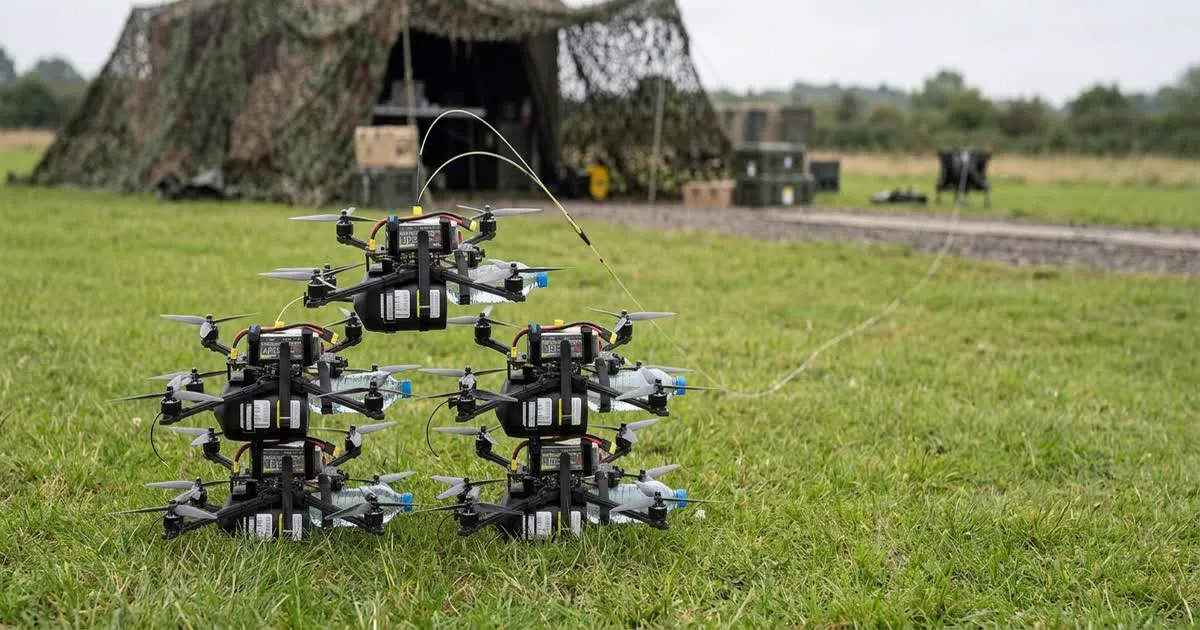
A fiber-optic FPV drone carries a spool of thin glass fiber on board. As the drone flies away from the pilot, the fiber unspools behind it. This keeps the drone wired to the ground unit for the whole flight. Control commands and video move as light pulses through this cable, not as radio waves through the air.
There is no radio signal to jam on this main link. Jamming works by flooding a receiver with noise on the frequency it listens to. A wired light link has no such frequency to attack. So it stays clear of that kind of interference.
Why This Matters for Reliability, Not Just Range
It is easy to think fiber-optic drones exist just to fly farther. But the real gain is reliability where radio conditions are poor or blocked on purpose. A place full of radio noise, thick walls, or active jamming can break a normal FPV link even at short range. A fiber link does not care about any of that. It only needs the cable itself to stay whole.
This is also why fiber-optic drones matter to counter-drone researchers and trainers. Our other article on training against fiber-optic drones looks at this from the defense side.
The Real Limits: Weight and Range
Nothing here is free. The fiber spool has weight. That weight grows as more cable unspools, since the drone is towing a longer cable as it flies. This cuts into payload space and flight time compared to a drone with no spool.
Range has a hard cap too. It is set by how much fiber the drone can carry. Once the spool runs out, the drone cannot go farther. Most of these builds have no backup radio link for control. So doubling your antenna gain will not help here, since there is no antenna doing the main job. The only lever is how much cable you carry. That has a hard weight limit.
Tangling and Cable Snags
The cable brings a new risk that a radio drone never faces. As the drone turns near trees, poles, corners or other objects, the trailing fiber can catch, wrap, or pull tight against something behind it.
A snagged cable can pull the drone off course. It can even stop the drone mid-flight. This changes how a pilot must plan a flight. You must think about the path of the cable, not just the path of the drone. Once the cable starts catching on things, those two paths are not the same.
Civilian and Research Relevance
Fiber-optic FPV technology is a small but real part of the wider drone field. Its main civilian use today is in counter-drone research, training and testing. Learning how a jam-proof link behaves helps defenders build detection tools that do not depend on jamming a radio signal that may not exist.
For hobby and paid FPV flying in Jordan, normal radio-linked drones stay the practical choice. They filmed, race, and fly freestyle without the weight cost or snag risk of a cable. Fiber-optic systems solve one narrow reliability problem. They are not a general upgrade over the radio-based FPV gear covered in the rest of this site.
What to Take Away
Fiber-optic FPV drones solve one clear problem well. They keep a link alive when radio cannot be trusted. They do this by giving up range, weight budget and free flight paths. That trade makes sense for a narrow set of research, training and special uses. It is not a general upgrade for filming or hobby flying.