
Quick Answer
Choosing an FPV battery means balancing cell count, capacity, and weight for your frame and flying style. Check that the C rating fits your peak current draw. Pick a connector your setup supports. Then decide between LiPo and Li-ion based on whether you want power or flight time. Good storage and charging habits matter just as much as the battery you buy.
Cell Count: Matching Voltage to Your Build
The number of cells in series is written as 3S, 4S, or 6S. This number sets your battery's voltage. Each LiPo cell is 3.7 volts nominal, 4.2 volts when full, and about 3.8 volts for storage. It must match what your motors, ESC, and flight controller can handle. Our comparison of 4S vs 6S for FPV covers how this choice affects power, efficiency, and weight.
Always check your build's rating before you buy a battery with a new cell count. The wrong voltage can damage expensive parts of your drone.
Capacity vs Weight
Capacity is measured in milliamp-hours, or mAh. It tells you how much energy a battery holds. A higher capacity usually means longer flight time. But it also means a heavier, bigger battery.
This creates a trade-off. A bigger battery gives more flight time per charge. But the extra weight makes your drone feel less nimble. The motors also work harder to lift that extra weight, which can eat into the gain. A light battery keeps your drone snappy and quick to respond. But you land sooner and need more battery swaps.
For freestyle and racing, most pilots pick the smallest battery that still gives them enough flight time. For cinematic or long-range flying, a bigger battery and more flight time often matter more than sharp handling.
Why C Ratings Are Often Inflated
The C rating is a number printed on a LiPo battery. It is meant to show how much current the battery can safely give. For example, a 1500mAh battery with a 75C rating claims up to 112.5 amps.
In practice, many printed C ratings are generous marketing numbers, not tested limits. Two batteries with the same printed rating, from different brands, can act very differently under real load. One may sag hard in voltage while the other holds steady.
Because of this, treat the C rating as a rough guide, not a hard promise. A better test is to fly the battery and watch for heavy voltage sag or heat. Trust brands with a solid, consistent track record over a battery that only boasts a huge C number on the label.
Connectors
The connector is the plug that links your battery to your drone's wiring. Common types are XT30, XT60, and XT90. Each one is rated for a different top current. XT30 suits small, low-power builds. XT60 and XT90 suit bigger builds that pull more current.
A connector rated below your real current draw can overheat, melt, or fail in flight. Match your connector to your build's current, not just to what fits the battery case. If you are not sure, check your ESC's documents for the right connector size.
LiPo vs Li-ion
LiPo, or lithium polymer, batteries are the classic FPV choice. They give high current in short, strong bursts. This suits the sudden power demands of freestyle and racing. But LiPo holds less energy per gram than some other cell types, and it can be damaged if punctured or drained too far.
Li-ion, or lithium-ion, batteries are often built from round cells. They hold more energy per gram than LiPo, but they give current less sharply. This makes them popular for long-range and efficient builds, where flight time matters more than sharp bursts of power. Our guide to building a long-range FPV drone covers this in more detail.
If you fly hard punches, flips, and fast direction changes, LiPo usually suits you best. If you fly long, steady flights and want the most time in the air, look at Li-ion instead.
Storage and Charging Habits
LiPo and Li-ion batteries both need basic care to stay safe and last longer.
- Storage voltage: Do not leave batteries at a full charge for long. Most chargers have a "storage" mode. This brings the battery to a safer, lower voltage for the days between flights.
- Temperature: Store batteries at room temperature, away from direct sun or heat. Heat speeds up aging and can be unsafe for damaged cells.
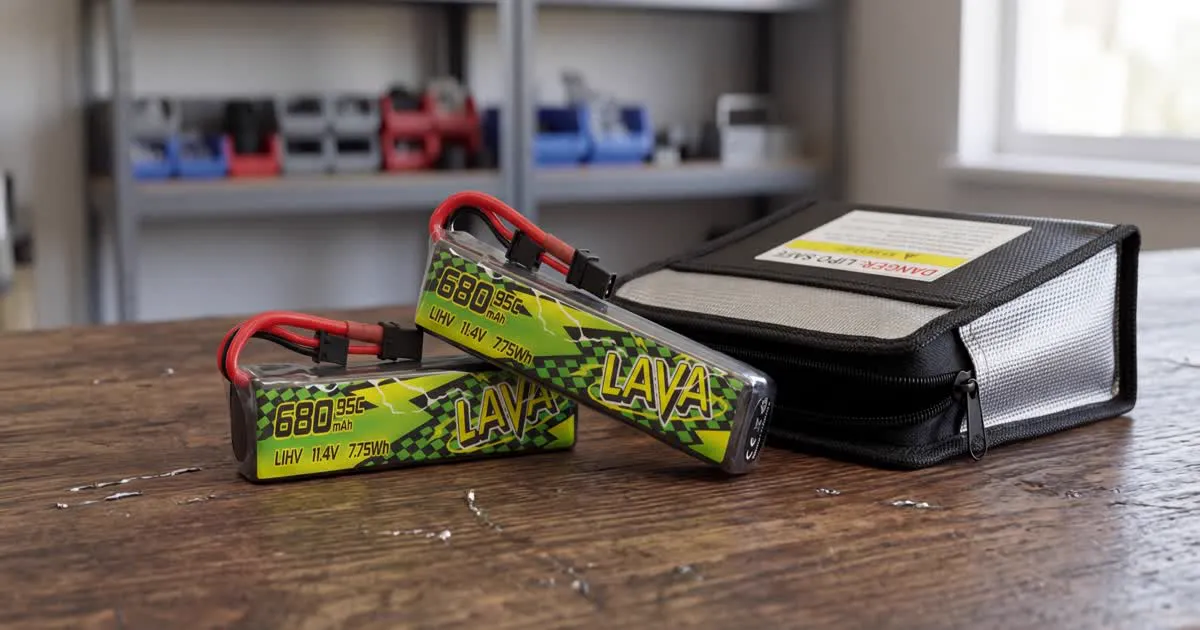
- Charging safely: Charge on a hard, fireproof surface, or inside a LiPo safety bag. Never leave a battery charging unattended for a long time.
- Checking for damage: Check batteries often for puffing, holes, or damaged wires. A puffed battery has swelled from gas inside it, and should be retired, not flown again.
A good charger helps keep your batteries healthy for longer. Our LiPo charger guide covers the features that actually matter when you buy one.
A Simple Buying Checklist
- Check the cell count matches your build's voltage rating.
- Pick a capacity that fits your frame and your flying goals.
- Choose a connector rated for your real current draw.
- Decide between LiPo and Li-ion based on power or flight time.
- Buy from a brand with a good, steady record, not just a high C number.