
Quick Answer
4S and 6S describe how many battery cells are wired in a series inside a LiPo pack, which sets the voltage available to your motors. 6S delivers more power at lower current for the same wattage, which often means more efficient flying and less heat, but it usually costs more to switch to and needs matching motors and an ESC rated for the higher voltage. Most freestyle and racing quads today run comfortably on either, so the right choice depends on your goals and your budget.
What 4S and 6S Actually Mean
The "S" in a battery name stands for "series," and the number tells you how many individual cells are connected end to end inside the pack. Each LiPo cell holds roughly 3.7 volts at storage and about 4.2 volts fully charged.
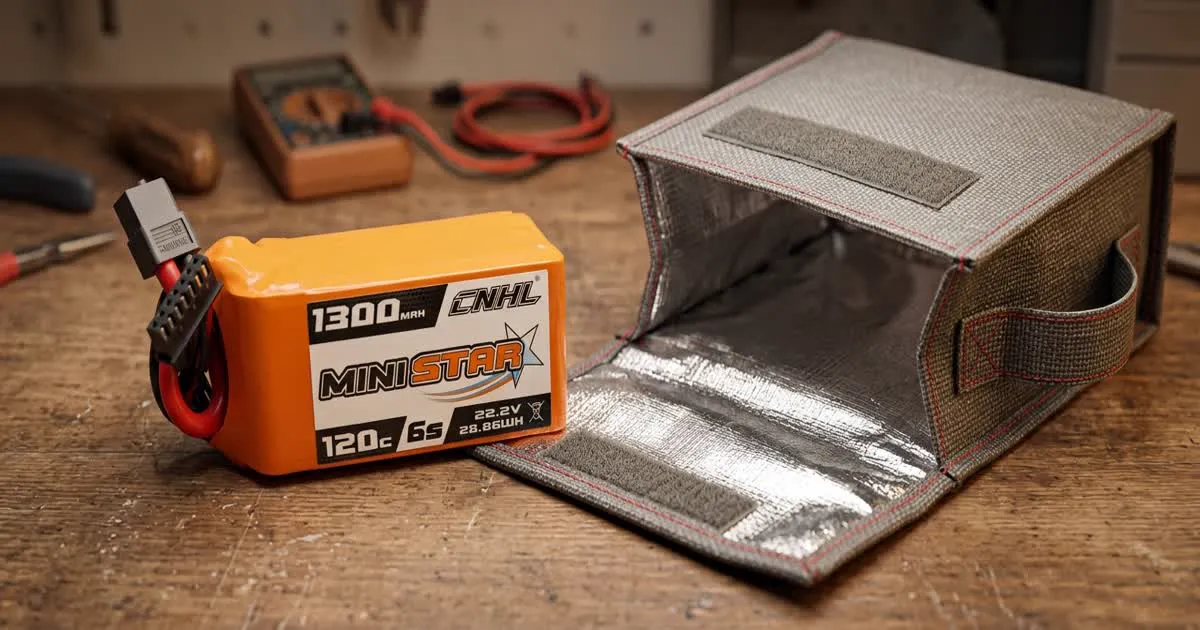
A 4S pack has four cells, giving about 14.8 volts nominal, or up to roughly 16.8 volts fully charged. A 6S pack has six cells, giving about 22.2 volts nominal, or up to roughly 25.2 volts fully charged. More cells in series means more voltage, which is the main practical difference between the two.
Voltage and Current: Why It Matters
Motors need a certain amount of power, measured in watts, to spin at a given speed and thrust. Power equals voltage multiplied by current. This means you can reach the same power output two ways: with lower voltage and higher current, or with higher voltage and lower current.
6S setups use higher voltage, so they need less current to produce the same power as a 4S setup. Lower current means less heat in your wires, connectors, and ESC, and less voltage sag under load. This is the main technical advantage 6S offers.
4S setups run at lower voltage, so components need to handle more current for the same power level. This puts more stress on connectors and wiring, especially on high-power builds, and can lead to more voltage sag from the battery during hard maneuvers.
Motor KV Pairing
KV describes how many RPM a motor spins per volt applied, with no load. Because 6S supplies more voltage than 4S, you generally need a lower KV motor on 6S to reach a similar prop speed as a higher KV motor on 4S. Our guide on understanding motor KV covers this relationship in more detail.
Using the wrong KV for your voltage can cause problems. A high KV motor on 6S may spin your props far too fast, drawing excess current and overheating quickly. A low KV motor on 4S may feel sluggish and underpowered. Manufacturers usually list a recommended voltage range for each motor, so check this before buying, rather than guessing.
Weight Differences
6S batteries are generally heavier than 4S batteries of a similar capacity, since they pack two extra cells into the case. This added weight is one reason pilots hesitate to switch, especially on lighter freestyle builds where every gram affects handling and flight time.
For larger frames, like 6 or 7-inch long-range builds, the weight difference matters less relative to the whole aircraft, and the efficiency gains from lower current often outweigh the extra grams. This is part of why many long-range builds, like those covered in our guide on building a long-range FPV drone, favor 6S or higher.
Cost of Switching
Moving from 4S to 6S is rarely a simple swap of one part. You typically need:
- New batteries rated for 6S voltage.
- Motors rated for 6S, or confirmed to handle the higher voltage safely.
- An ESC and flight controller stack rated to handle 6S voltage without damage.
- A charger capable of balancing and charging 6S packs.
If your current motors, ESCs, and charger are all only rated for 4S, switching to 6S means replacing several parts at once, which adds up in cost. This is worth planning for rather than discovering partway through a build.
Which Setup Fits Which Style of Flying
Freestyle: Both 4S and 6S work well. Many freestyle pilots stick with 4S for its lighter batteries and slightly softer power delivery, which some find easier to control smoothly. Others move to 6S for snappier throttle response and better efficiency.
Racing: 6S has become popular in competitive racing because of its efficiency and strong punch-out from turns, though 4S racing classes still exist and remain competitive on well-tuned builds.
Cinematic flying: Smooth, controlled power delivery matters more than raw punch for cinematic footage. Either voltage can work well here, with the choice often coming down to what motors and props best control precise, gentle movements.
Long-range flying: 6S, or higher voltage setups on Li-ion cells, are common because efficiency and flight time matter most, and the extra weight is a smaller fraction of a bigger aircraft.
Practical Advice for Choosing
If you already own a working 4S setup and are happy with your flight time and power, there is no urgent need to switch. If you are starting a new build from scratch, decide based on frame size and goals: smaller freestyle frames often do well on 4S, while larger frames built for range or efficiency benefit more from 6S.
Whichever you choose, always check your current sensor's calibration matches your setup, since inaccurate readings can affect flight time estimates. Our guide on current sensors explained covers how to check and calibrate this correctly.