
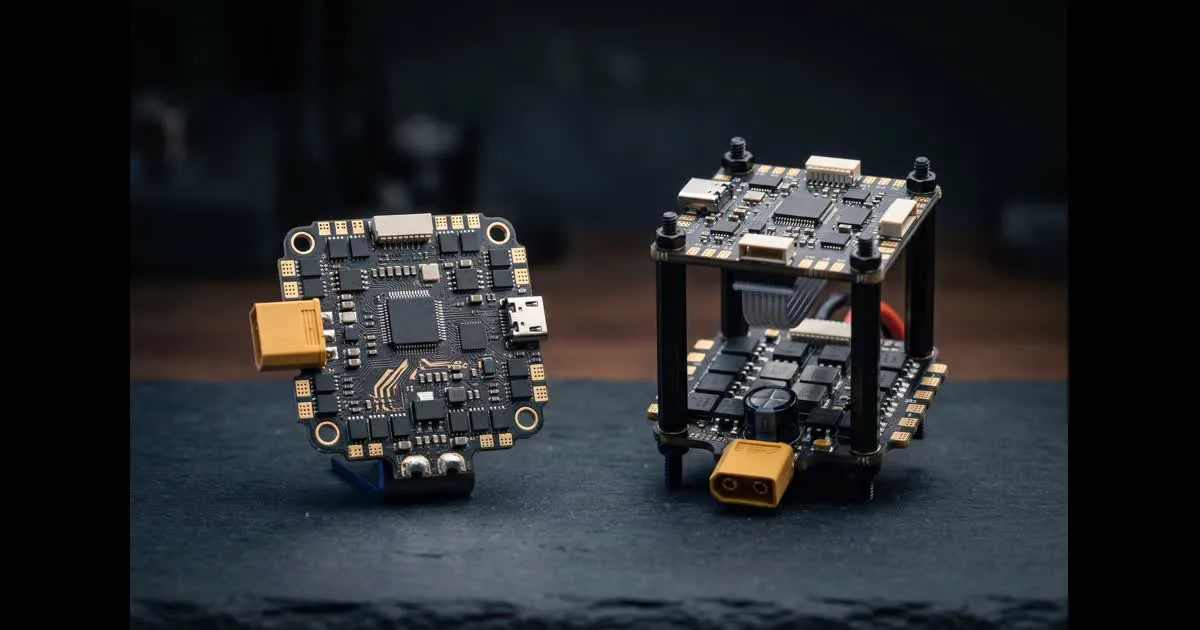
Quick Answer
An AIO (all-in-one) board combines the flight controller and ESC on one piece, saving weight and wiring but making repairs harder. A stack keeps the flight controller and ESC as separate boards, which costs a bit more space and weight but lets you replace one part without buying the other. Small and mid-size freestyle drones usually favor AIO boards, while high-current or heavy-lift builds often favor a stack.
What "AIO" and "Stack" Actually Mean
Every FPV drone needs a flight controller to manage stability and an ESC (electronic speed controller) to power the motors. These two jobs can either live on the same circuit board or on two separate boards connected by short wires.
- AIO board: the flight controller and ESC are built into one piece of hardware.
- Stack: the flight controller and ESC are separate boards, usually mounted one above the other with standoffs.
Both approaches do the same basic job. The difference is in how the parts are packaged.
The Case for an AIO Board
AIO boards have become popular on 3-inch to 5-inch freestyle drones for a few clear reasons.
- Less weight. One board with shared components weighs less than two separate boards.
- Simpler wiring. Fewer connections between the flight controller and ESC means a faster build and fewer soldering mistakes.
- Lower cost per board. Buying one combined unit is often cheaper than buying a flight controller and ESC separately.
- Cleaner stack height. A single thin board takes up less vertical space in the frame.
These benefits make AIO boards a strong choice for builders who want a quick, light and tidy quad without the highest possible current handling.
The Trade-Offs of Going AIO
The downside of combining two parts onto one board shows up when something breaks.
If the ESC section of an AIO board fails, for example from a motor short or a solder bridge, you often have to replace the entire board, including the working flight controller half. This makes repairs more expensive over time, especially if you crash often or fly hard.
AIO boards also tend to have lower current ratings per motor output compared to a dedicated high-current ESC. For most 4S and 5-inch freestyle setups, this is not a problem. For bigger builds pulling much higher current, it can become a limit. Our guide on how to match motors, ESCs and props explains how to check whether your planned current draw fits a given board.
The Case for a Separate Stack
A stack setup keeps the flight controller and ESC as two separate boards. This has its own set of advantages.
- Easier, cheaper repairs. If the ESC burns out, you replace only the ESC, not the flight controller.
- Higher current handling. Dedicated ESC boards, like the Holybro Tekko32 F4, are often built to handle more current per motor than an AIO design.
- More firmware flexibility on the ESC side. Separate ESCs are commonly flashed with firmware like AM32 or Bluejay, covered in our ESC firmware guide, and can be updated independently.
- Better fit for heavy-lift builds. Cinelifters and larger long-range drones often need the extra current headroom a dedicated ESC provides.
Weight and Space Trade-Offs
A stack adds a small amount of extra weight and stack height compared to an AIO board, mainly from the second set of standoffs, wires and connectors. On a small quad, this difference is noticeable in overall weight. On a larger build carrying a heavier battery and camera, the extra grams matter far less.
| Factor | AIO Board | Separate Stack |
|---|---|---|
| Weight | Lighter | Slightly heavier |
| Repair cost after a failure | Often full board replacement | Replace only the failed part |
| Typical current handling | Good for most freestyle builds | Often higher, suits heavy-lift |
| Build complexity | Simpler wiring | A few more connections |
| Best for | 3-inch to 5-inch freestyle | Heavy-lift, high-current, or repair-focused builds |
Which Should You Choose?
Think about your build size and how you plan to fly it.
Choose an AIO board if you are building a standard 3-inch to 5-inch freestyle or racing quad, want the lightest and simplest build, and are comfortable replacing the whole board occasionally after a hard crash.
Choose a stack if you are building a cinelifter, a long-range 7-inch drone, or any setup drawing high current, or if you would rather pay slightly more upfront to save on repair costs down the line. If you are still deciding on your overall board, our general flight controller buying guide covers the other specs to check alongside this decision.