
Quick Answer
An airspeed sensor measures how fast air moves past the aircraft. It uses a small tube called a pitot tube and a pressure sensor. This is not the same as GPS speed, which measures speed over the ground. Fixed-wing planes and VTOL aircraft need airspeed data. It helps them fly safely near stall speed and handle wind well during auto missions.
Airspeed vs Ground Speed
GPS gives you ground speed. This is how fast you move over the earth below. Airspeed is different. It is how fast air flows over the wings. That airflow is what keeps a plane in the air.
Picture a plane flying into a strong headwind. Its ground speed might read close to zero. Its airspeed is still high, since air still rushes past the wings fast. Now picture a strong tailwind. Ground speed looks great. But airspeed could be too low if the plane is not adding enough power.
This gap matters most during landing and slow flight. Flying by ground speed alone can put a plane closer to a stall than the pilot thinks.
How a Pitot Tube Works
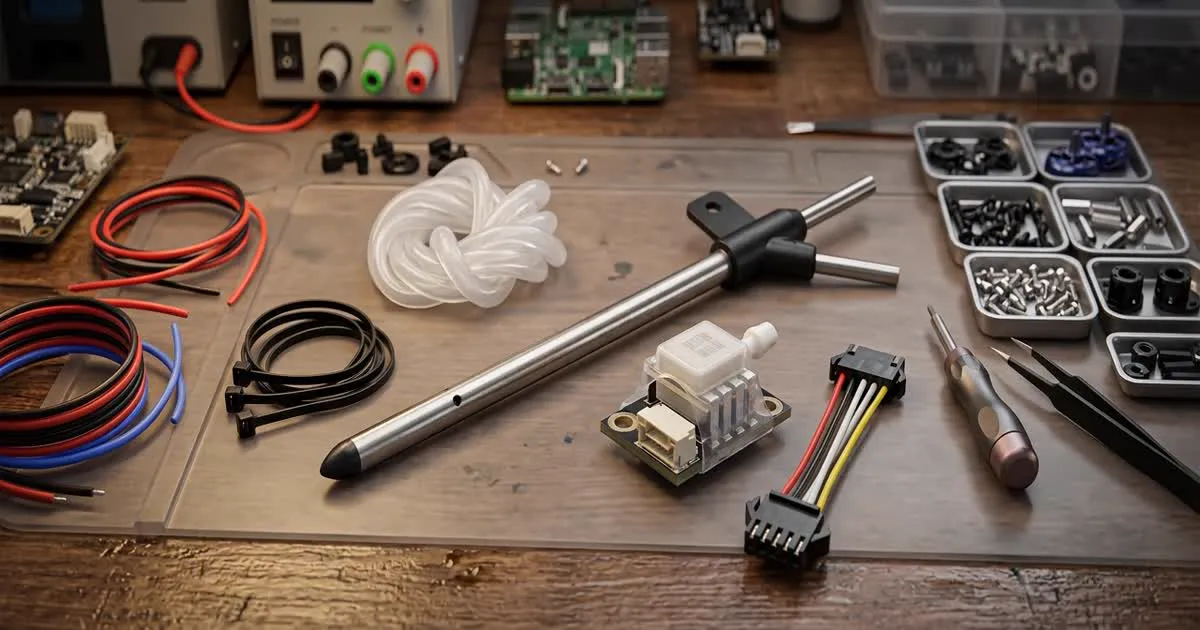
A pitot tube is a small tube that faces forward. It sits where it gets clean airflow, often on a wing or the nose. As the aircraft moves, air pressure builds up inside the tube. This is called dynamic pressure. It grows as speed grows.
The sensor also reads static pressure. This is the normal air pressure around the aircraft, taken from a separate port. The sensor compares the two. This gap is called differential pressure. From this gap, it works out airspeed using known math.
Mounting matters a lot here. A pitot tube in messy airflow gives bad readings. This can happen if it sits too close to a propeller or a large surface. Most makers say to mount it clear of prop wash and clear of large flat parts.
Why Fixed-Wing and VTOL Aircraft Need It
A multirotor can hover in place. It does not need forward airflow to stay up. A fixed-wing plane is different. It needs steady airflow over its wings, or it stalls and loses control.
ArduPilot's fixed-wing and VTOL modes use airspeed data in three ways. They manage throttle and pitch during auto missions. They keep the plane above stall speed in gusty air. They also help fly steady patterns on long survey flights.
Without an airspeed sensor, ArduPilot must guess airspeed from GPS speed and wind estimates. This guess is far less safe, mainly in windy weather. VTOL aircraft take off like a multirotor but cruise like a plane. They lean on airspeed data during the switch between hover and forward flight. A bad reading during that switch can cause a real loss of control.
Analog vs Digital Airspeed Sensors
Airspeed sensors come in two main types:
- Analog sensors send a raw voltage to the flight controller, which turns it into a speed value. These cost less but are more sensitive to electrical noise.
- Digital sensors work out the pressure onboard and send a clean digital number, often over I2C or DroneCAN. These tend to be more accurate and calmer under noise.
Most modern builds pick a digital sensor. This fits well when it shares a DroneCAN bus with other parts, like GPS and power modules. To learn how that shared bus works, see DroneCAN vs PWM.
Wiring and Placement
Beyond clean airflow, a few small things matter:
- Keep the pitot tube's line free of kinks. A pinched line gives a false low reading.
- Seal all tube joints well. A small air leak can throw off the pressure reading.
- Keep sensor wires away from power cables and motors. This cuts noise, mainly on analog sensors.
- Cover the pitot tube's opening in storage. Dirt or bugs can block it fully.
Calibrating an Airspeed Sensor in ArduPilot
Airspeed sensors need a check before their first flight. They may need it again later if readings start to drift:
- Wire the sensor and confirm ArduPilot sees it in Mission Planner.
- Run the ground check with no wind hitting the tube. This sets a correct zero point.
- Pick the airspeed sensor as your main source in the settings.
- Fly a short test flight. Compare the readings to your plane's known cruise speed.
- Adjust the ratio setting if readings read too high or too low.
For the full sensor setup, along with flow and compass, see ArduPilot sensor setup.
Do You Need One?
Fly a simple fixed-wing plane in calm air, sticking to manual or basic auto modes? You can get by without an airspeed sensor, though most guides still call it a smart choice for steady auto-throttle. Fly a VTOL aircraft, fly in windy spots, or run auto survey missions? An airspeed sensor is close to a must.